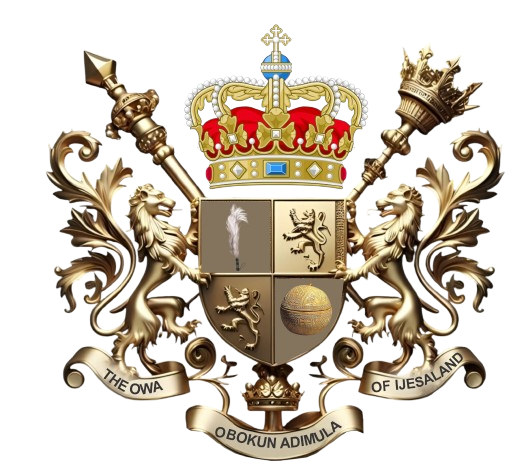
The Making of Ajimoko III: The Story of Owa Clement Adesuyi Haastrup
A Royal Birth in a Distant Land
September 18, 1948, was a sunny Sunday. There was so much jollification in the palace of the Olomu of Omu-Aran, in present day Kwara State of Nigeria, as a rapture of joy enveloped the air. The palace buzzed with excitement. It was the kind of inexpressible bliss that a couple feels at the birth of their first child. Yes, a prince had been born-but not just any prince. Though his roots were deeply Ijesa, fate had chosen the land of Kwara for his arrival. Clement Adesuyi Haastrup entered the world with a destiny as grand as his name, wrapped in the legacy of kings.
His father, Loja Claudius Adeniyi Haastrup, was no ordinary man-a shrewd contractor building bridges (literally and figuratively) between communities, while his mother, Madam Florence Dada Haastrup (Ifofin), was the kind of woman whose wisdom filled rooms. But young Adesuyi’s royal blood ran even deeper. His grandfather, Owa Alexander Fidipote Haastrup, Ajimoko II, was the reigning Owa Obokun of Ijesaland when he was born.
The Schoolboy Who Dreamed Big
Young Adesuyi’s early education was a tour of Nigeria’s finest. From Oro Ajimoko Primary School, Ilesa, to Holy Trinity School, Ebute Ero, Lagos, he soaked up knowledge like a sponge. By the time he hit Ijebu-Jesa Grammar School (1963-1964), and later Eko Boys High School (1964-1967), Lagos, Adesuyi had already mastered two key skills: cracking books and cracking jokes.
But it was at the Federal School of Science, Lagos, where he studied for his Higher School Certificate, HSC, (1968-1969), that he had his baptism of fire in politics, and his leadership spark ignited. In Lower Six, in 1968, he ran for Vice President of the Student Union. That was his first taste of politics.
From Port Clerk to Port Lord
In 1969, the template for one of life’s biggest ironies was laid. That year, Adesuyi landed a job as a tally clerk at Terminal C, Apapa Port, counting cargo under the scorching Lagos sun. Little did he know that, decades later, he would return as a grand master of those very terminals where he had laboured and toiled as a tally clerk. Life’s irony? Priceless.
Between juggling numbers at the port and clerking at the National Bank, Adesuyi knew one thing: he was meant for more. So, in 1970, he packed his bags and left Nigeria to chase the American Dream.
.
America, Pharmacy, and the Angel Who Paid His Bills
Between 1970 and 1974, Prince Haastrup was at Howard University, Washington D.C., where he swapped cargo manifests for chemistry formulas, earning a Pharmacy degree by 1974. He returned to Nigeria in 1981 and did his national service the following year. But here’s the twist: his tuition wasn’t paid by royal coffers when he was studying in America. Rather, it was a benevolent benefactor, Chief Bola Abimbola, who funded his education and his sister’s.
It was the same Chief Bola Abimbola who helped him set up his first pharmaceutical company, named Mediko Famasi. It was also at this critical juncture in his life that Prince Haastrup met the duo of Generals Ibrahim Badamasi Babangida and Abdulsalami Abubakar, who both ruled Nigeria at some point in its history. The phenomenal success that Haastrup made with Mediko Famasi eventually paved the way for other companies, like AGAAH Pharmacy, which he started in Gbagada, Lagos, in 1984; and the ENL Group, a construction firm, in 2001.
The Prescription For Political Success
Returning to Nigeria in 1981 with his Pharmacy degree and a sharp American accent, Haastrup discovered that politics was the real “wonder drug.” By 1990, he had dispensed himself straight into national limelight, becoming Deputy Governor under the then Osun State, Alhaji Isiaka Adetunji Adeleke, a.k.a. Seru Bawon. Adeleke was elected as the first civilian governor of Osun State and sworn in alongside Haastrup in January 1992 and they served until November 1993.
Though their tenure was short, Adesuyi Haastrup had firmly established his presence to the world of politics, policy and governance that he was a man of impact. Indeed, he was so effective on the beat that colleagues joked that the charming Prince’s pharmacy training made him expert at “treating” the state’s multitudinous administrative headaches.
During his tenure, he masterminded public-private partnerships that would make modern CEOs blush – from keeping the lights on with PHCN deals (or, NEPA as the electricity company was popularly known) to housing schemes that didn’t collapse.
The Prince and His Baby
Again, when Nigeria found itself at a political crossroads, Prince Adesuyi Haastrup, as Deputy Governor, started a quiet revolution. He began a campaign for Rotational Presidency as a veritable tool for sustainable political development in Nigeria. Wherever he went, and whatever platform he found himself, Haastrup was unrelenting in advocating for Rotational Presidency as sine qua non (necessary condition) for sustainable democracy; and a charter of equity that would give all the federating units or geopolitical zones equal opportunity to contribute to the national project.
From politics to ports
After his political “detox” in 1992, Haastrup swapped ballot boxes for business plans. In 2001, he founded the ENL Consortium – initially a modest utility company that soon grew like antibiotic-resistant bacteria. The big break came in 2006 when ENL grabbed the concession for Terminals C & D at Lagos’ Apapa Port 5. Under his watch, the port transformed from a nautical nightmare to West Africa’s shipping sweetheart, complete with 11 berths and labor reforms that actually worked. Not content with ruling the waves, his empire expanded into construction, power, and even mining.
Philanthropy with Personality
Haastrup’s idea of “networking” involves giving scholarships to 500+ students and keeping Nigeria’s hungry fed through his foundation. His wife, Olori Vicky, chair of Nigeria’s seaport operators, ensures that their dinner parties mix port logistics gossip with royal succession plans. Friends range from former political allies to business titans, all united in their bewilderment at the amazing tenacity of this soft-spoken gentle giant. “The man makes octopuses look lazy,” one associate joked.
Crowning Glory
When the throne of the Owa Obokun Adimula suddenly became vacant on Wednesday, September 11, 2024, when His Imperial Majesty, Oba Dr. Gabriel Adekunle Aromolaran II, joined his ancestors, the question on the lips of many Ijesas was: Here goes a great King. When cometh another?
They didn’t have to wait for too long. With an intimidating CV that makes him glitter like a thousand stars, it wasn’t too difficult for Kingmakers to select the former Deputy Governor of Osun State as the 41st Owa Obokun Adimula and Paramount Ruler of Ijesaland. For Haastrup, a new vista opened on Wednesday, December 27, 2024, when he outpaced nine rivals to emerge as the Owa Obokun-elect.
After Haastrup’s emergence, a visibly elated Governor Ademola Adeleke of Osun State declared: “We’re promoting him from Deputy Governor to King, hope he doesn’t ask for a pay rise”.
Through his body language and conversations he has been having with Nigerians since he emerged as the Paramount Ruler of Ijesaland, Owa Clement Adesuyi Haastrup, Ajimoko III, has his eyes firmly focused on bigger matters. Ahead of his royal coronation on Friday, May 23, 2025, the pharmacist-turned-port-baron-turned-monarch has been perfecting plans to make Ijesaland the “Dubai of West Africa”. His development agenda spans an agricultural revolution that would churn out many agri-preneurs, mining development, training of tech gurus that would positively deploy their talents and skills to turning Ijesaland to an info tech hub. Of course, better traffic management is also on the table.
Whether dispensing medicines, political wisdom, or port management solutions, Haastrup’s life proves that with enough vigour (and strategic caffeine intake), one can indeed conquer multiple worlds. As Ijesaland prepares to seat its new king on May 23, 2025, the only question remaining is: “Your Highness, when do you sleep?”